Commonwealth field guide · Hampton Roads
A practical guide to yard drainage in Hampton Roads
Learn how roof runoff, low grades, compacted soil and limited outlets create wet yards in Hampton Roads—and how contractors choose among grading, catch basins, French drains and other solutions.
A wet yard is not a diagnosis. It is evidence that water is entering, crossing or remaining on the property faster than the site can move or absorb it. The useful question is not “Which drain should I buy?” It is “What is producing this water, where can it travel and what destination can accept it?”
Why drainage problems are common here
Hampton Roads is a coastal region with flat terrain, intense rainfall events and many developed lots where roofs, driveways and patios concentrate water into relatively small areas. Even a modest change in elevation can determine whether runoff continues toward a street inlet, settles in the lawn or moves toward a neighboring property.
Construction also changes how soil behaves. Repeated equipment traffic can compact the ground, and imported fill may drain differently from the soil beneath it. A lawn may look level in dry weather while still containing a shallow basin that becomes obvious only after rain.
Start with four observations
Good drainage work begins with evidence collected during and after rainfall. Photos and short videos can reveal patterns that disappear before a contractor arrives. Record the same locations at the beginning of the storm, during peak runoff and several hours later.
- Source: roof downspouts, adjoining land, pavement, groundwater seepage or rainfall on the yard itself.
- Path: sheet flow across turf, a concentrated channel, flow beside the foundation or water trapped behind a hard surface.
- Duration: how long water stands and whether the soil remains soft for days after the visible puddle is gone.
- Destination: street drainage, an approved outfall, a lower landscape area with adequate capacity or another lawful discharge point.
What the common solutions actually do
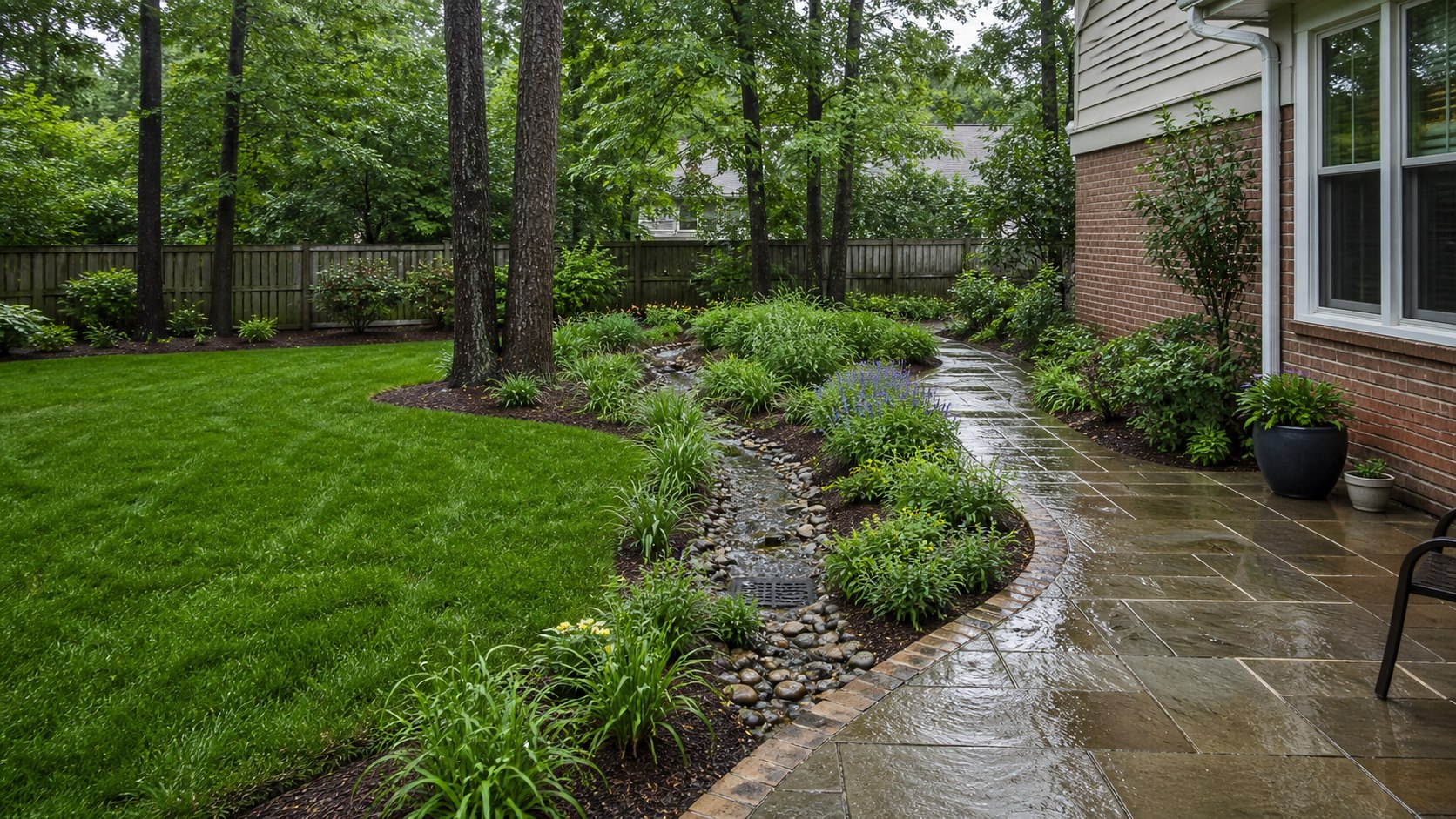
Different drainage components solve different hydraulic problems. Catch basins collect surface flow at a defined low point. Solid pipe conveys roof or basin water without intentionally absorbing more water along the route. A French drain intercepts subsurface moisture through a stone-filled trench and perforated pipe. A swale uses a broad, shallow grade to keep water moving across the surface. A dry well or rain garden stores water temporarily so it can infiltrate where soil and site conditions allow.
Many durable projects combine components. A downspout may connect to solid pipe, a low lawn area may receive a catch basin, and minor regrading may remove the depression that kept water from reaching the inlet. The system should remain accessible for cleanout and inspection.
Why a French drain sometimes disappoints
A French drain is useful when subsurface water can enter the stone trench and the pipe has continuous fall to a workable outlet. It is less effective when the main problem is roof water pouring onto the surface, when the pipe has nowhere lower to discharge or when fine soil quickly migrates into an improperly filtered stone bed.
A buried line can also move the symptom without solving the cause. If water is discharged into another low area, toward a structure or onto neighboring land, the project has not produced a responsible result. Outlet elevation and capacity should be confirmed before excavation begins.
Questions to ask before approving a proposal
A useful proposal should describe more than linear feet of pipe. Ask the contractor to identify the water source, the reason each component was selected, the intended outlet, the areas that will be disturbed and how the finished grade and turf will be restored.
- Where will the collected water discharge, and is that destination permitted and large enough for the expected flow?
- Which sections use solid pipe and which use perforated pipe—and why?
- How will soil be kept from contaminating the drainage stone?
- Where are the cleanouts or accessible inlets for future maintenance?
- What changes if excavation reveals utilities, unsuitable soil or an outlet elevation that differs from the initial assumption?
Know when the problem belongs to another specialist
Exterior landscape drainage is not a substitute for structural engineering, foundation waterproofing, plumbing repair, septic work or municipal storm-sewer maintenance. Water entering through a foundation, a suspected broken utility, recurring street flooding or significant erosion near a structure may require another licensed specialist or the appropriate city department.
A responsible landscape contractor should be willing to define that boundary. The goal is not to sell a drain; it is to direct the property owner toward the work that actually addresses the risk.
Further reading
These primary resources informed the regional and technical context in this guide.